ChatGPT Getting Worse? Why Users Feel It’s “Dumber” — and What’s Actually Changing
If you’ve used ChatGPT regularly over the last couple of years, you’ve probably had this moment at least once:
You type a detailed prompt. You explain exactly what you want. Maybe you even clarify it twice.
And somehow the answer still comes back shorter, flatter, or oddly off-track.
That growing frustration is exactly why searches like “ChatGPT getting worse,” “did ChatGPT get worse,” and “why is ChatGPT getting worse” have exploded recently. Reddit threads are packed with complaints about lazy answers, context loss, random refusals, and responses that feel less thoughtful than they used to.
Some users believe the platform has genuinely declined. Others think expectations simply got higher after the “wow factor” wore off.
The truth is somewhere in the middle.
After testing long conversations, coding prompts, and research-heavy workflows across multiple ChatGPT versions, one thing becomes obvious: the experience absolutely feels different now compared to earlier GPT-4 era releases. But that doesn’t necessarily mean the AI suddenly became “bad.”
A lot has changed behind the scenes — from safety tuning and model optimization to context management and inference costs. And depending on how you use ChatGPT, those changes can either feel like an improvement… or a major downgrade.
The reason the “ChatGPT getting worse” debate keeps growing is because people are noticing these differences in real everyday use, not just benchmarks or AI demos.
So, is ChatGPT getting worse in 2026? Let’s unpack what users are actually experiencing, why it happens, and whether the complaints are justified.
Why People Think ChatGPT Is Getting Worse
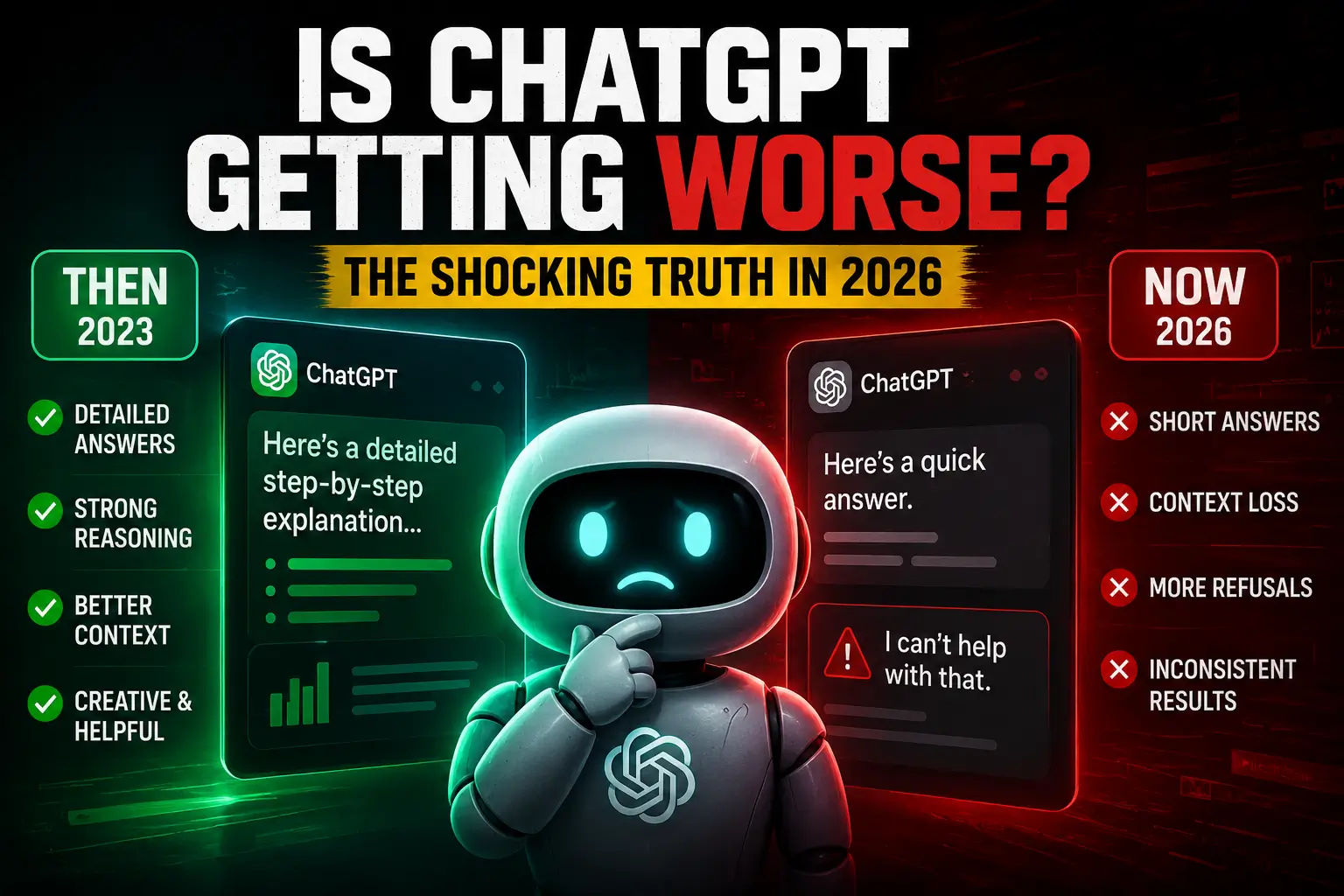
The biggest reason people feel ChatGPT is getting worse is consistency.
Earlier versions of ChatGPT often felt surprisingly detailed and proactive. You could ask complicated questions, throw massive prompts at it, or brainstorm ideas for hours, and the model would usually stay engaged.
Now? Many users describe a completely different experience.
Common complaints include:
- Shorter, lower-effort responses
- Repetitive phrasing
- Losing track of earlier instructions
- More frequent safety refusals
- Generic summaries instead of deep analysis
- Inconsistent coding output
- Ignoring formatting requests
And honestly, some of these complaints aren’t just internet exaggeration.
One of the strangest things about using ChatGPT in 2026 is how unpredictable it can feel. Some days the model produces incredibly detailed responses with strong reasoning. Other days, the exact same prompt generates a shallow paragraph and a disclaimer-heavy answer.
That inconsistency frustrates long-time users more than anything else.
Especially power users.
If you use ChatGPT casually for quick questions, brainstorming, or rewriting emails, newer versions may feel perfectly fine. But people using it daily for coding, research, SEO workflows, scripting, or long-form analysis tend to notice behavioral changes much faster.
And in some cases, there’s measurable evidence behind those perceptions.
A widely discussed Stanford and Berkeley study from 2023 found noticeable behavior drift in GPT models over time. GPT-4 reportedly became worse at certain math and instruction-following tasks between March and June of that year, even while improving in other areas.
So the idea that ChatGPT’s behavior changes over time is not just speculation. Model behavior absolutely evolves — sometimes in ways users immediately notice.
That’s a major reason why “ChatGPT getting worse” discussions continue spreading across Reddit, forums, YouTube, and tech communities.
The “Lazy Answers” Problem
A huge part of the “ChatGPT getting worse” conversation revolves around what many users call lazy answers.
You ask for:
- detailed analysis
- step-by-step breakdowns
- long-form explanations
- fully commented code
…and instead you get:
- a quick summary
- generic bullet points
- stripped-down code
- surface-level explanations
This is probably the single most common frustration repeated across Reddit and OpenAI forum discussions.
Anyone using ChatGPT heavily for technical work has likely experienced it.
You’ll notice patterns like:
- the model skipping requested detail
- compressing explanations unnecessarily
- simplifying complex tasks too aggressively
- avoiding nuance unless repeatedly pushed
Sometimes it even feels like the AI is trying to end the conversation as quickly as possible.
That sounds dramatic, but it’s a surprisingly common complaint tied directly to the “ChatGPT getting worse” debate online.
Why Does This Happen?
There are several possible explanations.
1. Safety Tuning
Modern ChatGPT models are significantly more safety-focused than earlier releases.
That means:
- more restrictions
- more refusal behavior
- more cautious wording
- less willingness to speculate
Safer systems are often less expressive systems.
In practice, this can make responses feel flatter or overly sanitized.
2. Response Optimization
Large AI models are incredibly expensive to run.
As platforms scale to hundreds of millions of users, companies naturally optimize:
- inference speed
- GPU efficiency
- token usage
- response length
Shorter answers are cheaper and faster.
That doesn’t automatically mean OpenAI intentionally “made ChatGPT worse,” but operational efficiency almost certainly influences how responses are generated.
This is one reason why many people searching “is ChatGPT getting worse” believe answers now feel more compressed than before.
3. Instruction-Following Drift
Some research suggests that model behavior drifts over time due to updates, tuning changes, and safety adjustments.
This can affect:
- formatting consistency
- reasoning depth
- prompt adherence
- coding reliability
Which explains why older prompts sometimes stop working as effectively months later.
For long-time users, this gradual drift is part of why ChatGPT getting worse has become such a widely discussed topic.
Does ChatGPT Get Worse the Longer the Conversation?
In many real-world situations, yes.
And this is one of the few complaints with a very strong technical explanation behind it.
If you’ve ever noticed ChatGPT becoming confused, forgetful, or inconsistent deep into a long thread, you’re not imagining it.
Context Dilution Is Real
ChatGPT relies on a context window — essentially the working memory used to process a conversation.
As chats become longer:
- more tokens compete for attention
- earlier instructions lose influence
- conversation history becomes harder to prioritize
The result?
The AI starts:
- forgetting constraints
- contradicting earlier statements
- ignoring formatting rules
- drifting away from the original task
This is why users often say:
“ChatGPT gets worse the longer the conversation goes.”
During testing, this issue becomes especially noticeable in:
- coding sessions
- SEO workflows
- research-heavy chats
- multi-step planning
- long editing sessions
After roughly 40–50 messages, behavior often becomes fuzzier even without technically hitting token limits.
And once context drift begins, quality can decline fast.
This specific issue is one of the biggest reasons “ChatGPT getting worse” complaints continue appearing across Reddit and OpenAI forums.
Why Fresh Chats Often Work Better
A lot of experienced users now restart chats constantly.
Not because they want to — because output quality often improves immediately in a fresh thread.
That’s become a surprisingly common workflow among developers, writers, and researchers.
Fresh chats reduce:
- context confusion
- instruction conflicts
- memory dilution
- accumulated errors
It’s not elegant, but it works.
For many power users, restarting chats has basically become a workaround for the whole “ChatGPT getting worse” experience.
Did OpenAI Reduce Quality to Save Costs?
This theory appears constantly across AI communities.
The basic argument goes like this:
As ChatGPT scaled massively, OpenAI had to optimize operational costs. To do that, newer models became:
- faster
- lighter
- more compressed
- less computationally intensive
And according to critics, that optimization reduced response depth and reasoning quality.
There’s no public evidence proving OpenAI intentionally downgraded ChatGPT across the board.
But there are a few reasons why people believe something changed.
Why Users Suspect Cost Optimization
Several noticeable shifts happened over time:
- responses became shorter
- GPT-4 Turbo variants appeared
- answers became more cautious
- coding output felt more condensed
- reasoning sometimes felt less detailed
For heavy users, the behavioral difference felt obvious.
One developer on the OpenAI forums described it as:
“The model feels optimized for throughput rather than depth.”
That idea resonates with many power users.
Especially programmers.
Earlier GPT-4 era models often produced extremely verbose code explanations with detailed comments and reasoning. Newer versions can feel more compressed and utilitarian by comparison.
Again, this doesn’t necessarily mean the model is objectively worse.
But it may mean priorities changed.
And for many users, that shift is exactly why the “ChatGPT getting worse” discussion keeps resurfacing online.
Real User Complaints Across Reddit and Forums
Search “ChatGPT getting worse Reddit” and you’ll immediately find hundreds of complaints.
Some trends show up repeatedly across discussions:
“It Feels Lazy”
This is by far the biggest complaint.
Users describe responses as:
- rushed
- generic
- repetitive
- low effort
Even detailed prompts sometimes receive shallow outputs unless users repeatedly push for depth.
This “lazy answer” feeling is now deeply connected to the broader “ChatGPT getting worse” narrative.
“It Keeps Forgetting Instructions”
This becomes especially common in long conversations.
People complain that:
- formatting rules disappear
- tone changes randomly
- project requirements get ignored
- previously established constraints vanish
Many users now re-paste instructions multiple times during long workflows just to keep outputs stable.
“Coding Quality Dropped”
Developers frequently mention:
- missing edge cases
- incomplete functions
- broken formatting
- reduced explanation depth
Some even say they now rely more heavily on alternatives like Anthropic’s Claude for long technical tasks.
For developers especially, the “ChatGPT getting worse” complaints often center around coding reliability and long-session consistency.
“The Same Prompt Gives Different Results”
Consistency has become another major complaint.
You might paste the same prompt:
- one day → excellent answer
- next day → weak summary
That unpredictability makes ChatGPT harder to trust for mission-critical workflows.
And it’s one of the biggest reasons why searches for “is ChatGPT getting worse” continue trending.
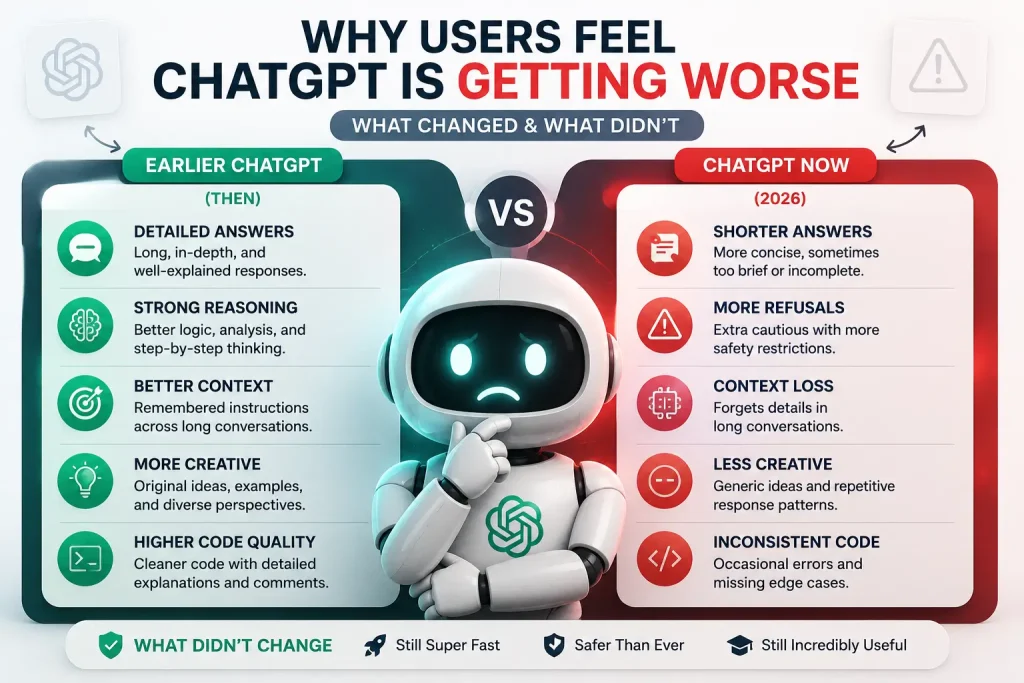
Old vs New ChatGPT Behavior
The differences become clearer when you compare real-world usage patterns.
| Task | Older ChatGPT Feel | Newer ChatGPT Feel |
|---|---|---|
| Coding help | More detailed explanations and comments | Faster but often shorter |
| Long conversations | Better memory retention | More context drift |
| Research tasks | More exploratory and nuanced | More summarized |
| Safety handling | More open-ended | More cautious and restrictive |
| Creative writing | More experimental | More structured and controlled |
| Prompt adherence | Better with long instructions | Sometimes ignores constraints |
This obviously varies by model and use case.
But broadly speaking, many experienced users describe newer ChatGPT versions as:
- faster
- safer
- cleaner
…but also:
- less exploratory
- less detailed
- less “alive”
That last part matters more than people realize.
A lot of users became emotionally attached to how surprisingly thoughtful earlier ChatGPT versions felt. When that tone changes, the downgrade feels personal — even if benchmark performance improves elsewhere.
That emotional shift is another hidden reason the “ChatGPT getting worse” discussion resonates with so many people online.
Why Some Users Think ChatGPT Is Better Now
Not everyone thinks ChatGPT got worse.
In fact, some users strongly prefer newer versions.
Faster Responses
Modern ChatGPT versions are generally quicker.
For everyday tasks like:
- summarizing
- brainstorming
- rewriting
- casual Q&A
…the speed improvements are noticeable.
Better Safety Controls
Some people absolutely prefer stricter safeguards.
Earlier AI systems occasionally produced:
- harmful advice
- inaccurate claims
- dangerous suggestions
Newer safety systems reduce a lot of that risk.
Even users participating in “ChatGPT getting worse” discussions sometimes admit the platform is safer and more stable overall.
More Natural Conversation
For casual conversation, newer models often feel smoother and friendlier.
The chatbot personality is generally:
- more polished
- more emotionally aware
- more conversational
That matters for mainstream users.
Better Multimodal Features
Modern ChatGPT versions now support:
- image understanding
- file analysis
- memory systems
- advanced voice interactions
So while some reasoning behavior may frustrate power users, the overall platform has become much more capable in other areas.
How to Get Better Results From ChatGPT
If ChatGPT feels worse lately, your workflow matters more than ever.
Small prompting changes can dramatically improve output quality.
1. Be Extremely Specific
Instead of:
“Explain this.”
Try:
“Explain this in 500 words using practical examples and full paragraphs.”
Specificity matters.
A lot.
This alone can reduce the “ChatGPT getting worse” feeling for many users.
2. Restart Long Chats
This alone solves many quality problems.
Fresh chats often restore:
- better reasoning
- stronger focus
- more accurate outputs
Especially for technical tasks.
3. Re-State Important Rules
During long workflows, repeat critical instructions occasionally.
For example:
- desired tone
- formatting requirements
- constraints
- writing style
This helps fight context drift.
4. Avoid Overloaded Prompts
Massive prompts with 15 instructions often backfire.
Breaking requests into smaller chunks usually works better.
5. Treat ChatGPT Like a Collaborator — Not Magic
This mindset shift helps enormously.
The best results usually come from:
- iterative prompting
- feedback loops
- refinement
- clarification
Not one-shot prompts.
Many advanced users who once believed ChatGPT getting worse was ruining their workflow found that better prompting habits improved results significantly.

Final Verdict: Is ChatGPT Getting Worse?
The honest answer?
For some use cases, yes.
Long-time users aren’t imagining the behavioral differences. Newer ChatGPT experiences can absolutely feel:
- shorter
- more cautious
- less detailed
- less consistent in long chats
And there are legitimate technical reasons behind that perception:
- safety tuning
- context dilution
- optimization trade-offs
- evolving model behavior
At the same time, ChatGPT is still one of the most capable AI systems available to the public.
For many users, it remains incredibly useful for:
- writing
- brainstorming
- coding
- research
- productivity
- learning
The bigger reality is this:
ChatGPT hasn’t simply become “bad.” It has evolved in ways that benefit some users while frustrating others.
Power users chasing deep reasoning and long-context reliability tend to notice the downsides more intensely. Casual users focused on speed and convenience often see improvements.
So instead of asking:
“Did ChatGPT get worse?”
…the better question might be:
“Is ChatGPT still the right tool for the way I use AI?”
For millions of people, the answer is still yes — just with a bit more prompt engineering than before.
And ultimately, the entire “ChatGPT getting worse” debate reflects something bigger: people now rely on AI tools heavily enough to notice even subtle behavioral changes.
FAQ
Is ChatGPT getting worse in 2026?
Many users believe ChatGPT feels less detailed and more inconsistent compared to earlier GPT-4 era versions. Complaints usually focus on shorter answers, context loss, and increased safety refusals.
Why are “ChatGPT getting worse” discussions trending online?
The topic is trending because many long-time users feel newer ChatGPT versions behave differently during coding, research, and long conversations. Reddit and forum complaints have amplified those concerns.
Why does ChatGPT forget instructions in long conversations?
Long chats create context dilution. As conversations grow, earlier instructions receive less attention inside the model’s context window, causing memory drift and inconsistency.
Did OpenAI intentionally make ChatGPT worse?
There’s no public evidence showing OpenAI deliberately downgraded ChatGPT. However, safety tuning, optimization changes, and efficiency improvements may affect how responses feel to users.
Does ChatGPT get worse the longer you use it?
Not permanently, but long conversation threads can reduce response quality over time due to context overload and attention limitations.
What are the best alternatives to ChatGPT right now?
Popular alternatives include Anthropic Claude, Google Gemini, and Microsoft Copilot depending on your workflow and use case.